BIO
SHORT BIO:
• 1978-1989: TATTOOING FRIENDS OFF AND ON / PART-TIME THROUGHOUT THE DECADE.
• 1990-1994: LEARNED PROFESSIONAL TATTOOING FROM RICK WALTERS.
• 1994-2001: FULL-TIME TATTOOER @ KARI BARBAS'OUTER LIMITS TATTOO, ANAHEIM CALIFORNIA,
• 2001-2003: MANAGER & TATTOOER - OUTER LIMITS COSTA MESA, CALIFORNIA.
• 2004-2009: HART & HUNTINGTON LEAD TATTOOER AT THE PALMS HOTEL CASINO, LAS VEGAS, NV.
• 2005-2006: A&E TV SHOW "INKED".
• 2009-2011: WORKING OUT OF KENT KELLEY’S STAYTRUE TATTOO LAS VEGAS, NEVADA.
• 2011–PRESENT: WORKING PRIVATELY: PEONY TATTOOO LAS VEGAS.
• 2014: NAMED AS ONE OF THE WORLDS TOP 50 TATTOOERS IN "TATTOO" MAGAZINES “TATTOO MASTERS” ISSUE #1.
——————————————————————--
LONG BIO:
•Born in Chadron Nebraska July 1963. At the age of four his family moved to Maywood California in east Los Angeles. In 1969 they moved to Huntington Beach CA, it was a small motorcycle club / beach bum neighborhood where he spent the remainder of his youth.
Directly inspired by the original 1800's Japanese tattoo artists. Putting decades of tattooing experience & study into it as well. Classic Japanese has been Clarks favorite form of tattoo since age 11 (1974). Clark did his first tattoos in 1977 - 78 ~ tattooing friends & their friends off & on until he got serious in the late 80's... and he's been at it full time ever since.
• Having a strong passion for traditional Japanese tattooing, these days clark is focused solely in this one direction. Body suits are a passion but so are sleeves, shoulder & hip decor as well as smaller one point tattooing.
• Clark is always sketching, drawing and painting new ideas as well as tattooing 5 days a week. He enjoys his careers path and is grateful for his great clientele, past and present.
Classic Japanese Style tattooer based out of the Las Vegas NV area • Did 1st tattoos in 1978.
Though primarily self-taught Clark was mentored by some of the American Wests most respected tattooers: Mark Mahoney • Rick Walters R.I.P. • Mike Brown R.I.P. • Kari Barba • Catfish Carl R.I.P.
Though he's a homebody that likes life un-complicated - Clark has more than 30,000 hours in the skin, was on the TV show INKED 2005—2007 and has been featured in all of tattooing's longest lived magazines. He has also been interviewed & quoted in the newspapers USA Today, Los Angeles Times, Orange County Times and the & O.C Weekly.
In the late 1970s Clark was Occasionally tattooing friends and their friends. For the next decade he was helped out with his needle making and other hand tattooing techniques (similar to tebori) from Mike Brown (Tattooland Whittier / Anaheim CA) & Mark Mahoney (the Rose Tattoo on the Pike Long Beach & later at Tattooland Anaheim CA). Throughout this time most everything he knew was from these two mentors.
In early 1987 (age 23) Clark received a thumbs up to start an apprenticeship-
but... that weekend Clark was injured in a large fireworks accident - with shrapnel injuries to his face, arms and legs. Thus he lost his eye, had throat & mouth lacerations including a torn uvula also a broken nose, a cracked orbital plate and cheekbone,
For the next three weeks Clark was in and out of the hospital with multiple surgeries including reconstructive and other issues. This three week mind-blow was compounded by his mothers death (at the age of 53). This was the end of her battle with leukemia. It was a horrible few weeks and unfortunately he lost his stride. He in turn lost his passion for many things... including drawing & tattooing, it was a discouraging time. (as well as loosing his eye - he lost most of the eyelid, both his upper and lower, preventing the use of a prothesis (glass eye).
On advise from close family Clark moved to Florida, Nocatee Florida, to live with his mothers sister Verna (Verna Taylor Keller) whom Clark was close. In 1988/89 helped by Verna and family he began drawing again.
After a year or so in Florida he moved back to Huntington Beach to continue his path. Unfortunately his previous mentioned apprenticeship was no longer available. Simply put Clark was told he'd no longer make a good tattooer since now he only had one eye.
Even though drawing and tattooing were more difficult - he continued doing tattoos once in a while just like before.
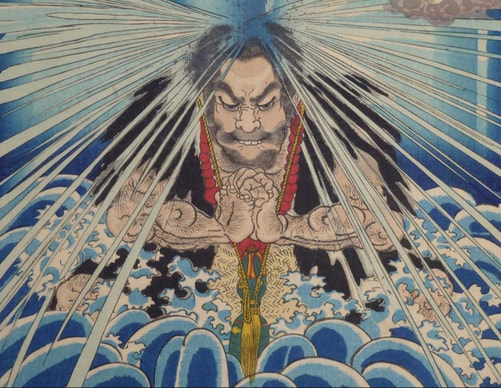 Art by Kuniyoshi
In the late 1990's Mark Mahoney sent Clark to Rick Walters - Rick offered to help him and keep him headed in the direction for "Professional Tattooing". Rick helped Clark on everything from needle, tube and machine making to flash painting to putting in tattoos that would last a clients lifetime. Rick taught him how to be professional rather than the way he had been doing it for the past decade.
That was when Rick was at Bert Grimm's Tattoo on the Pike in Long Beach, CA... He was the manager there, running the shop for the Shaw's the last 25 years it was opened. Rick helped Clark from then on.
During this time Clark still worked his day job - did it from 4:00am till noon, then he would go hang with Rick - 1 till 3 or 4. Then he would tattoo from 5 till 1 or 2 in the morning. He did this for a few years until he got good enough at it to get a job working for Kari Barba in 1994.
In 1990 Clark married his first wife Holly, Clark's first son Ian was born in September 1991 and his second son Cameron was born in April 1993. Clark's marriage to Holly lasted until 94.
Clark went to work at Kari Barba's "Outer Limits Tattoo"
in Anaheim, CA in 1994 -formerly Twilight Fantasy). In 1996 he got together with Terri (his current wife) and they moved to L.B., CA.
In 2001 Clark became manager for Kari Barba when she opened her Outer Limits Tattoo in Costa Mesa, CA.
In 2003 Clark was asked to move to Las Vegas to be on
•A&E TV's "Inked"
- He was involved with the show until filming ended in 2006.
at that time Clark worked as lead tattooer and sub-manager at
•Carey Hart's "Hart & Huntington" tattoo.
in 2007 he started doing his work out of-
•Kent Kelley's "Staytrue Tattoo".
He plied his trade with Kent until 2011 at which time he went to work privately and on the road.
Today he works privately & is still based in Las Vegas.
With more than 30,000 hours in the skin and tattooing more than 25,000 clients, Clark is focused on Japanese / fusion style large work.
Clark has the utmost respect and the deepest gratitude to his wife and children- for their patience and understanding. A tattooers life is sometimes very difficult to understand. His mother and father (Phyllis Estella Taylor-North R.I.P. and Frank Reagle North R.I.P.), his Aunt and all of Verna's immediate family whom helped him so much through a very rough year. Clark would also like to show respect to his mentors for the truly un-selfish gifts that they each gave to him. He would like to thank his children's mother Holly for the great gift of lineage that she’s given him. Clark has the deepest gratitude to Kent Kelley and Carey Hart for what they each did for him and all the great years that he spent with each of them.
And not least Clark wants to thank & honor all of the clients that he ever had the privilege to tattoo, thank you for letting him be a part of each one of your lives!
That was when Rick was at Bert Grimm's Tattoo on the Pike in Long Beach, CA... He was the manager there, running the shop for the Shaw's the last 25 years it was opened. Rick helped Clark from then on.
During this time Clark still worked his day job - did it from 4:00am till noon, then he would go hang with Rick - 1 till 3 or 4. Then he would tattoo from 5 till 1 or 2 in the morning. He did this for a few years until he got good enough at it to get a job working for Kari Barba in 1994.
In 1990 Clark married his first wife Holly, Clark's first son Ian was born in September 1991 and his second son Cameron was born in April 1993. Clark's marriage to Holly lasted until 94.
Clark went to work at Kari Barba's "Outer Limits Tattoo"
in Anaheim, CA in 1994 -formerly Twilight Fantasy). In 1996 he got together with Terri (his current wife) and they moved to L.B., CA.
In 2001 Clark became manager for Kari Barba when she opened her Outer Limits Tattoo in Costa Mesa, CA.
In 2003 Clark was asked to move to Las Vegas to be on
•A&E TV's "Inked"
- He was involved with the show until filming ended in 2006.
at that time Clark worked as lead tattooer and sub-manager at
•Carey Hart's "Hart & Huntington" tattoo.
in 2007 he started doing his work out of-
•Kent Kelley's "Staytrue Tattoo".
He plied his trade with Kent until 2011 at which time he went to work privately and on the road.
Today he works privately & is still based in Las Vegas.
With more than 30,000 hours in the skin and tattooing more than 25,000 clients, Clark is focused on Japanese / fusion style large work.
Clark has the utmost respect and the deepest gratitude to his wife and children- for their patience and understanding. A tattooers life is sometimes very difficult to understand. His mother and father (Phyllis Estella Taylor-North R.I.P. and Frank Reagle North R.I.P.), his Aunt and all of Verna's immediate family whom helped him so much through a very rough year. Clark would also like to show respect to his mentors for the truly un-selfish gifts that they each gave to him. He would like to thank his children's mother Holly for the great gift of lineage that she’s given him. Clark has the deepest gratitude to Kent Kelley and Carey Hart for what they each did for him and all the great years that he spent with each of them.
And not least Clark wants to thank & honor all of the clients that he ever had the privilege to tattoo, thank you for letting him be a part of each one of your lives!
There are a lot of tabs on this site - a couple tattoo photo pages including favorites from over the years, lots of tattoo flash, some of Clarks gouache portraiture and his store where you can buy prints & affordable reproductions of over 60 illustrations by him, or of course you may want a hoodie & a t-shirt. We hope you enjoy browsing, please come back from time to time to see what Clark is up to.
A&E Tattoo TV Show "INKED" 2004-2006
INTERVIEW VIMEO VIDEO
ARTS VISUALS VIMEO VIDEO
Social Networks
Facebook.com/Clark.North
Instagram @ClarkNorthTattoo
Tumblr @ClarkNorthFineArts
Black Market Art Company
Twitter
Find the contact page on this web-site... please don't use facebook, twitter, tumbler or instagram for booking appointments or messages.
INTERVIEW VIMEO VIDEO
ARTS VISUALS VIMEO VIDEO
Social Networks
Facebook.com/Clark.North
Instagram @ClarkNorthTattoo
Tumblr @ClarkNorthFineArts
Black Market Art Company
Find the contact page on this web-site... please don't use facebook, twitter, tumbler or instagram for booking appointments or messages.